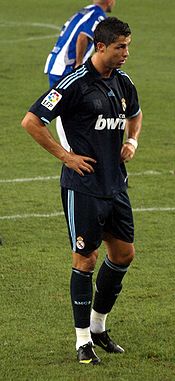
Cristiano Ronaldo dos Santos Aveiro, OIH (Portuguese pronunciation: [kɾɨʃˈtiɐnu ʁuˈnaɫdu]; born 5 February 1985)[1] is a Portuguese footballer who plays as a winger for Spanish club Real Madrid and serves as captain of the Portuguese national team. Ronaldo currently holds the distinction of being the most expensive player in football history after having transferred to Real Madrid in a deal worth £80 million (€94m, US$132m). His contract with Real Madrid is believed to have made him the highest-paid player in the world.[2]
Ronaldo began his career as a youth player at CD Nacional and his successes with the team led to a move to Sporting Clube de Portugal two seasons afterwards. Ronaldo's precocious talent caught the attention of Manchester United manager Alex Ferguson and he signed the 18-year-old for £12.24 million in 2003. The following season, Ronaldo won his first club honour, the FA Cup, and reached the UEFA Euro 2004 final with Portugal, in which tournament he scored his first international goal.
In 2008, Ronaldo won his first UEFA Champions League title, and was named player of the tournament. He was named the FIFPro World Player of the Year[3] and the FIFA World Player of the Year, in addition to becoming Manchester United's first Ballon d'Or winner in 40 years.[4]
Three-time Ballon d'Or winner Johan Cruyff said in an interview on 2 April 2008, "Ronaldo is better than George Best and Denis Law, who were two brilliant and great players in the history of United."[5]
Early life
Cristiano Ronaldo dos Santos Aveiro was born on 5 February 1985 in Funchal, Madeira, the youngest child of Maria Dolores dos Santos Aveiro and José Dinis Aveiro. His second given name, "Ronaldo," was chosen after then-U.S. president Ronald Reagan, who was his father's favourite actor.[6] He has one older brother, Hugo, and two older sisters, Elma and Liliana Cátia.[1]
Club career
Early career
At the age of eight, Ronaldo played for amateur team Andorinha, where his father was the kit man. In 1995, Ronaldo signed with local club CD Nacional, and, after a title-winning campaign, he went on a three-day trial with Sporting CP, who subsequently signed him for an undisclosed sum.[7]
Sporting CP
Ronaldo joined Sporting's other youth players who trained at the Alcochete, the club's football academy. He became the only player ever to play for Sporting's U-16, U-17, U-18, B-team, and first team, all within one season.[8] He scored two goals in his Sporting debut against Moreirense, while featuring for Portugal in the UEFA Under 17 Championships.[9]
When he was 15, Ronaldo was diagnosed with a racing heart, a condition that might have forced him to give up playing football. The Sporting staff were made aware of the condition and Ronaldo's mother gave her authorisation for him to go into hospital. While there, he had an operation in which a laser was used to cauterise the area of his heart that was causing the problem. The surgery took place in the morning and Ronaldo was discharged from hospital by the end of the afternoon; he resumed training only a few days later.[10]
He was first spotted by then-Liverpool manager Gérard Houllier at 16, but Liverpool declined to take him on because they decided he was too young and needed some time to develop his skills.[11] However, he came to the attention of Manchester United manager Alex Ferguson in the summer of 2003, when Sporting defeated United 3–1 in the inauguration of the Estádio José Alvalade in Lisbon. Ronaldo's performance impressed the Manchester United players, who urged Ferguson to sign him.[12]
Manchester United
2003–2005
Ronaldo became Manchester United's first-ever Portuguese player when he signed for £12.24 million after the 2002–03 season.[13] He requested the number 28 (his number at Sporting), as he did not want the pressure of living up to the expectation linked to the number 7 shirt, which had previously been worn by players such as George Best, Bryan Robson, Eric Cantona, and David Beckham. "After I joined, the manager asked me what number I'd like. I said 28. But Ferguson said 'No, you're going to have No. 7,' and the famous shirt was an extra source of motivation. I was forced to live up to such an honour."[14]
Ronaldo made his team debut as a 60th-minute substitute in a 4-0 home victory over Bolton Wanderers. He scored his first goal for Manchester United with a free kick in a 3–0 win over Portsmouth on 1 November 2003. He scored United's thousandth Premier League goal on 29 October 2005 in a 4–1 loss to Middlesbrough. He scored ten goals in all competitions, and fans voted him to his first FIFPro Special Young Player of the Year award in 2005.
2006–2007
In November and December 2006, Ronaldo received consecutive Barclays Player of the Month honours, becoming only the third player in Premier League history to do so after Dennis Bergkamp in 1997 and Robbie Fowler in 1996.[15][16] He scored his 50th Manchester United goal against city rivals Manchester City on 5 May 2007 as United claimed their first Premier League title in four years, and he was voted into his second consecutive FIFPro Special Young Player of the Year award at the end of the year.
Despite rumours circulating in March 2007 that Real Madrid were willing to pay an unprecedented €80 million (£54 million) for Ronaldo,[17] he signed a five-year, £120,000-a-week (£31 million total) extension with United on 13 April, making him the highest-paid player in team history.[18][19]
Ronaldo amassed a host of personal awards for the season. He won the PFA Players' Player of the Year and PFA Young Player of the Year awards, joining Andy Gray (in 1977) as the only players to receive this honour.[20] In April, he completed the treble by winning the PFA Fans' Player of the Year. Ronaldo was also one of seven Manchester United players named in the 2006–07 PFA Premier League Team of the Year.
2007–2008
Ronaldo's 2007–08 season began with a red card for a headbutt on Portsmouth player Richard Hughes during United's second match of the season, for which he was punished with a three-match ban.[21] Ronaldo said he had "learned a lot" from the experience and would not let players "provoke" him in the future.[22] After scoring the only goal in a Champions League away match against Sporting, Ronaldo also scored the injury-time winner in the return fixture as Manchester United topped their Champions League group.[23]
He finished as the runner-up to Kaká for the 2007 Ballon d'Or,[24] and was third in the running for the FIFA World Player of the Year award, behind Kaká and Lionel Messi.[25]
Ronaldo scored his first hat trick for Manchester United in a 6–0 win against Newcastle United at Old Trafford on 12 January 2008, bringing Manchester United up to the top of the Premier League table.[26] He scored his twenty-third league goal of the season in a 2–0 win against Reading, equalling his entire total for the 2006–07 season.[27] During a 1–1 Champions League first knockout round draw against Lyon on 20 February, an unidentified Lyon supporter continuously aimed a green laser at Ronaldo and United teammate Nani, prompting an investigation by UEFA.[28] One month later, Lyon were fined CHF5,000 (£2,427) for the incident.[29]
On 19 March 2008, Ronaldo captained United for the first time in his career in a home win over Bolton, scoring both goals in the 2–0 victory.[30] The second of the goals was his 33rd of the campaign, which set a new club single-season scoring record by a midfielder and thus topped George Best's forty-year-old total of 32 goals in the 1967–68 season.[31] Ronaldo scored another brace in a 4–0 win over Aston Villa on 29 March, which at the time gave him 35 goals in 37 domestic and European matches as both a starter and substitute. Ronaldo's torrid scoring streak was rewarded with his becoming the first winger to win the 2007–08 European Golden Shoe, finishing eight points ahead of Mallorca's Dani Güiza.[32]
In the 2007–08 Champions League final on 21 May against league rivals Chelsea, Ronaldo scored the opening goal after 26 minutes, which was negated by a Chelsea equaliser in the 45th minute as the match ended 1–1 after extra time. His misfire in the penalty shoot-out put Chelsea in position to win the trophy, but John Terry shot wide right after slipping on the pitch surface, and Manchester United emerged victorious 6–5 on penalties. Ronaldo was named the UEFA Fans' Man of the Match,[33] and wrapped up the campaign with a career-high 42 goals in all competitions, falling just four short of Denis Law's team-record mark of 46 in the 1963–64 season.
2008–2009
On 5 June 2008, Sky Sports reported that Ronaldo had expressed an interest in moving to Real Madrid if they offered him the same amount of money the team had allegedly promised him earlier in the year.[34] Manchester United filed a tampering complaint with FIFA on 9 June over Madrid's alleged pursuit of Ronaldo, but FIFA declined to take any action.[35][36] Speculation that a transfer would happen continued until 6 August, when Ronaldo confirmed that he would stay at Manchester for at least another year.[37]
Ronaldo underwent ankle surgery at the Academic Medical Center in Amsterdam on 7 July.[38] He returned to action on 17 September in United's UEFA Champions League goalless group-stage draw with Villarreal as a substitute for Park Ji-Sung,[39] and scored his first overall goal of the season in a 3–1 League Cup third round win over Middlesbrough on 24 September.
In a 5–0 win over Stoke City on 15 November 2008, Ronaldo scored his 100th and 101st goals in all competitions for Manchester United, both from free kicks.[40] The goals also meant that Ronaldo had now scored against each of the other 19 teams in the Premier League at the time.[41] On 2 December, Ronaldo became Manchester United's first Ballon d'Or recipient since George Best in 1968. He finished with 446 points, 165 ahead of runner-up Lionel Messi.[42] He was awarded the Silver Ball after finishing with two goals as United won the Club World Cup on 19 December.[43]
On 8 January 2009, Ronaldo was uninjured in a single-car accident in which he wrote off his Ferrari 599 GTB Fiorano in a tunnel along the A538 near Manchester Airport. A breathalyzer test he gave to police officers at the scene was negative, and he attended training later that morning.[44] Four days later, he became the first Premier League player ever to be named the FIFA World Player of the Year, in addition to being the first Portuguese player to win the award since Luís Figo in 2001.[45]
Ronaldo scored his first Champions League goal of the season, and first since the final against Chelsea, in a 2–0 victory over Internazionale that sent United into the quarter-finals.[46] In the second leg against Porto, Ronaldo scored a 40-yard game-winning goal as United advanced to the semi-finals. He later called it the best goal he had ever scored.[47][48] Ronaldo participated in his second consecutive Champions League final, but made little impact in United's 2–0 loss to Barcelona. He finished with 53 appearances in all competitions, which was four higher than the previous year, but scored sixteen fewer goals (26) than his career-best total of 42 from the previous season.
On 11 June, Manchester United accepted an unconditional offer of £80 million from Real Madrid for Ronaldo after it was revealed that he again had expressed his desire to leave the club.[49] It was confirmed by a representative of the Glazer family that the sale was fully condoned by Ferguson.[50] When Ronaldo had eventually completed his transfer to Real, he expressed his gratitude towards Ferguson for helping him develop as a player, saying, "He's been my father in sport, one of the most important factors and most influential in my career."[51]
Real Madrid
On 26 June 2009, Real Madrid confirmed that Ronaldo would join the club on 1 July 2009, after agreeing terms and signing a six-year contract.[52] It is believed that Ronaldo's contract is worth €13 million per season and it has a €1 billion buy-out clause.[53] He was presented to the world's media as a Real Madrid player on 6 July 2009,[54] where he was handed the number 9 jersey,[55] most recently worn by Javier Saviola, who left for Benfica in Portugal. The shirt was presented to him by Madrid legend Alfredo di Stéfano.[56] Ronaldo was welcomed by 80,000 fans at his presentation at the Santiago Bernabéu Stadium, surpassing Diego Maradona's record of 75,000 fans when he was presented in Italy, after he was transferred from Barcelona to Napoli in 1984.[57]
Ronaldo made his debut for Real on 21 July against Irish side Shamrock Rovers; Madrid won the match 1–0 after a late goal from Karim Benzema. His first goal for the club, a penalty, came in another pre-season friendly, against Ecuadorian team LDU Quito.[58] On 29 August, Ronaldo capped his La Liga debut with a goal, scoring Real's second from the penalty spot in a 3–2 home win against Deportivo La Coruña.[59] On 15 September, Ronaldo had a successful start to his Champions League career at Madrid, as he scored two goals away against FC Zürich in a 5–2 win, both of which were free-kicks.[60] Ronaldo scored a brace for Real during a 5–0 win over newly-promoted Xerez at the Bernabéu on 20 September;[61] he scored in Real's next match against Villareal, thus breaking a club record by becoming the first ever player to score in his first four league matches.[62] Ronaldo continued his fine form for Real in his next Champions League game on 30 September, against Marseille, scoring two goals in a 3–0 victory at the Bernabéu.[63] On 10 October 2009, Ronaldo picked up an injury whilst playing for Portugal against Hungary,[64] and was expected to be out for 2-3 months,[65] however Ronaldo himself said he was targeting the Champions League match against Milan on 3 November as a possible comeback date.[66][67][68]. After tests done by the Real Madrid medical staff came back stating minimal progress on the healing of his injury, Ronaldo had set the return date for the match against FC Barcelona on the 29th of November.[69][70] However, he was given the thumbs up by the medical staff and made the squad list for the Champion's League match day 5 clash with FC Zurich on 25 November. As he warmed up and finally stepped up to the touch line to enter the match as a substitute, the crowds at the Santiago Bernabéu cheered and welcomed back their star after 55 days on the injured list, and he came on in the 69th minute for Raúl. He was featured in the starting XI list for the first time since being injured for the 29 November El Classico defeat at the Camp Nou, which ended 1-0.
International career
Ronaldo earned his first cap for Portugal in a 1-0 victory against Kazakhstan on 20 August 2003.[71] He was called up for Euro 2004,[72] scoring in a 2-1 group stage loss to eventual champions Greece[73] and in a 2-1 semi-final win over the Netherlands.[74] He was named in the team of the tournament despite finishing with only two goals.[75] That same year, he also represented Portugal at the 2004 Summer Olympics.[76][77]
2006 World Cup
Ronaldo was the second-highest scorer in FIFA World Cup qualification in the European zone with seven goals,[75] and scored his first and only World Cup goal against Iran with a penalty kick.[78]
During a quarter-final match against England on 1 July 2006, Ronaldo's United teammate Wayne Rooney was sent off for stamping on Portugal defender Ricardo Carvalho. The English media speculated that Ronaldo had influenced referee Horacio Elizondo's decision by aggressively complaining, after which he was seen in replays winking at the Portuguese bench following Rooney's dismissal. After the match, Ronaldo insisted that Rooney was a friend and that he was not pushing for Rooney to be sent off.[79] On 4 July, Elizondo clarified that the red card was due to Rooney's infraction and not the fracas between Rooney and Ronaldo that followed.[80]
The angry reaction from the English press caused Ronaldo to consider leaving United,[81] and he allegedly told Spanish sports daily Marca that he wished to move to Real Madrid.[82] In response to the speculation, Ferguson sent Portuguese assistant manager Carlos Queiroz to speak to Ronaldo in attempt to change his mind, a sentiment that was shared by Rooney.[83][84] Ronaldo stayed, and signed his new five-year extension in April 2007.[85]
Ronaldo was booed during Portugal's semifinal defeat to France,[86] and missed out on the competition's Best Young Player award due to a negative e-mail campaign from England fans.[87] Though the online vote only affected the nomination process, FIFA's Technical Study Group awarded the honour to Germany's Lukas Podolski, citing Ronaldo's behaviour as a factor in the decision.[88]
Post-World Cup
One day after his twenty-second birthday, Ronaldo captained Portugal for the first time in a friendly against Brazil on 6 February 2007.[89] This move was in honour of Portuguese Football Federation president Carlos Silva, who had died two days earlier. Portugal coach Luiz Felipe Scolari explained, "Mr. Silva asked me to make [Ronaldo] captain as a gesture... [he] is too young to be captain, but Mr. Silva asked me, and now he is no longer with us."[90]
Ronaldo scored eight goals in Portugal's UEFA Euro 2008 qualifying campaign,[91] behind Poland's Ebi Smolarek, but finished with only one goal in the tournament as Portugal were eliminated in the quarter-finals by Germany.[92][93] Since the appointment of new Portuguese coach Carlos Queiroz,[94] Ronaldo has been named the new captain of the squad.[95]
On 10 September, 2009, in a World Cup qualification match against Hungary, Ronaldo provided an assist for the first goal scored by Simão and Portugal went to win the game 3–0. Following the win against Malta by 4 - 0, and the Sweden loss to Denmark, Portugal advanced to the 2nd place which leads to the playoff. Ronaldo was called-up for the play-offs with much controversy and disagreement from the Merengues, due to the injury he had aggravated on the game against Hungary, and was submitted to physicals by the Portuguese team but was later announced his inability to play against Bosnia and Herzegovina.
Personal life
Ronaldo's father José Dinis Aveiro died of alcoholism at age 52 when Ronaldo was 20. Ronaldo does not consume alcohol and does not smoke.[98][99]
Ronaldo has a close relationship with his mother. During March 2009, he donated £100,000 to the hospital which helped saved his mother's life after she was diagnosed with breast cancer in 2007.[100]
Ronaldo wrote an autobiography about his life up until 2007. This was entitled Moments and was published on 15 December 2007.[101]
Along with one of his sisters, Ronaldo opened a fashion boutique under the name "CR7" (comprising his initials and shirt number).[102] There are currently only two CR7 store locations open, both of which are in Portugal, one being in Lisbon and the other in Madeira.
On October 2009, designer
Giorgio Armani announced Ronaldo would be taking over from
David Beckham as the spokesmodel for
Emporio Armani men's underwear and jeans. He will begin appearing in a new worldwide advertising campaign starting in spring 2010.
International goals
Cristiano Ronaldo: International goals | # | Date | Venue | Opponent | Score | Result | Competition |
| 1 | 12 June 2004 | Estádio do Dragão, Porto, Portugal |  Greece Greece | 1–2 | 1–2 | Euro 2004 |
| 2 | 30 June 2004 | Estádio José Alvalade, Lisbon, Portugal |  Netherlands Netherlands | 2–0 | 2–1 | Euro 2004 |
| 3 | 4 September 2004 | Skonto stadions, Riga, Latvia |  Latvia Latvia | 0–1 | 0–2 | World Cup 2006 Qualifying |
| 4 | 8 September 2004 | Estádio Dr. Magalhães Pessoa, Leiria, Portugal |  Estonia Estonia | 1–0 | 4–0 | World Cup 2006 Qualifying |
| 5 | 13 October 2004 | Estádio José Alvalade, Lisbon, Portugal |  Russia Russia | 2–0 | 7–1 | World Cup 2006 Qualifying |
| 6 | 13 October 2004 | Estádio José Alvalade, Lisbon, Portugal | Russia | 4–0 | 7–1 | World Cup 2006 Qualifying |
| 7 | 17 November 2004 | Stade Josy Barthel, Luxemburg City, Luxembourg |  Luxembourg Luxembourg | 0–2 | 0–5 | World Cup 2006 Qualifying |
| 8 | 4 June 2005 | Estádio da Luz, Lisbon, Portugal |  Slovakia Slovakia | 2–0 | 2–0 | World Cup 2006 Qualifying |
| 9 | 8 June 2005 | A. Le Coq Arena, Tallinn, Estonia | Estonia | 0–1 | 0–1 | World Cup 2006 Qualifying |
| 10 | 1 March 2006 | LTU Arena, Düsseldorf, Germany |  Saudi Arabia Saudi Arabia | 0–1 | 0–3 | Friendly |
| 11 | 1 March 2006 | LTU Arena, Düsseldorf, Germany | Saudi Arabia | 0–3 | 0–3 | Friendly |
| 12 | 17 June 2006 | Waldstadion, Frankfurt, Germany |  Iran Iran | 2–0 | 2–0 | World Cup 2006 |
| 13 | 7 October 2006 | Estádio do Bessa, Porto, Portugal |  Azerbaijan Azerbaijan | 1–0 | 3–0 | Euro 2008 Qualifying |
| 14 | 7 October 2006 | Estádio do Bessa, Porto, Portugal | Azerbaijan | 3–0 | 3–0 | Euro 2008 Qualifying |
| 15 | 15 November 2006 | Estádio Cidade de Coimbra, Coimbra, Portugal |  Kazakhstan Kazakhstan | 2–0 | 3–0 | Euro 2008 Qualifying |
| 16 | 24 March 2007 | Estádio José Alvalade, Lisbon, Portugal |  Belgium Belgium | 2–0 | 4–0 | Euro 2008 Qualifying |
| 17 | 24 March 2007 | Estádio José Alvalade, Lisbon, Portugal | Belgium | 4–0 | 4–0 | Euro 2008 Qualifying |
| 18 | 22 August 2007 | Hanrapetakan Stadium, Yerevan, Armenia |  Armenia Armenia | 1–1 | 1–1 | Euro 2008 Qualifying |
| 19 | 8 September 2007 | Estádio da Luz, Lisbon, Portugal |  Poland Poland | 2–1 | 2–2 | Euro 2008 Qualifying |
| 20 | 17 October 2007 | Almaty Central Stadium, Almaty, Kazakhstan | Kazakhstan | 0–2 | 1–2 | Euro 2008 Qualifying |
| 21 | 11 June 2008 | Stade de Genève, Geneva, Switzerland |  Czech Republic Czech Republic | 1–2 | 1–3 | Euro 2008 |
| 22 | 11 February 2009 | Estádio Algarve, Faro, Portugal |  Finland Finland | 1–0 | 1–0 | Friendly |
Career statistics
| Club | Season | League | Cup | League Cup | Europe | Other1 | Total |
| Apps | Goals | Apps | Goals | Apps | Goals | Apps | Goals | Apps | Goals | Apps | Goals |
| Sporting CP | 2002–03 | 25 | 3 | 3 | 2 | – | 3 | 0 | 0 | 0 | 31 | 5 |
| Total | 25 | 3 | 3 | 2 | – | 3 | 0 | 0 | 0 | 31 | 5 |
| Manchester United | 2003–04 | 29 | 4 | 5 | 2 | 1 | 0 | 5 | 0 | 0 | 0 | 40 | 6 |
| 2004–05 | 33 | 5 | 7 | 4 | 2 | 0 | 8 | 0 | 0 | 0 | 50 | 9 |
| 2005–06 | 33 | 9 | 2 | 0 | 4 | 2 | 8 | 1 | 0 | 0 | 47 | 12 |
| 2006–07 | 34 | 17 | 7 | 3 | 1 | 0 | 11 | 3 | 0 | 0 | 53 | 23 |
| 2007–08 | 34 | 31 | 3 | 3 | 0 | 0 | 11 | 8 | 1 | 0 | 49 | 42 |
| 2008–09 | 33 | 18 | 2 | 1 | 4 | 2 | 12 | 4 | 2 | 1 | 53 | 26 |
| Total | 196 | 84 | 26 | 13 | 12 | 4 | 55 | 16 | 3 | 1 | 292 | 118 |
| Real Madrid | 2009–10 | 5 | 5 | 0 | 0 | – | 3 | 4 | 0 | 0 | 8 | 9 |
| Total | 5 | 5 | 0 | 0 | – | 3 | 4 | 0 | 0 | 8 | 9 |
| Career total | 226 | 92 | 29 | 15 | 12 | 4 | 61 | 20 | 3 | 1 | 331 | 132 |
Statistics accurate as of match played 25 November 2009[96]
1Includes other competitive competitions, including the Portuguese SuperCup, FA Community Shield, UEFA Super Cup, Intercontinental Cup, FIFA Club World Cup and Supercopa de España.
Honours
Club
Manchester United
Individual
- UEFA Euro 2004 Team of the Tournament
- FIFPro Special Young Player of the Year: 2004–05, 2005–06
- Portuguese Footballer of the Year: 2006–07
- UEFA Team of the Year: 2003–2004, 2006–07, 2007–08
- FIFPro World XI: 2006–07, 2007–08
- PFA Young Player of the Year: 2006–07
- PFA Players' Player of the Year: 2006–07, 2007–08
- PFA Fans' Player of the Year: 2006–07, 2007–08
- PFA Premier League Team of the Year: 2005–06, 2006–07, 2007–08, 2008–09
- FWA Footballer of the Year: 2006–07, 2007–08
- Barclays Player of the Season: 2006–07, 2007–08
- Barclays Player of the Month: November 2006, December 2006, January 2008, March 2008
- Barclays Golden Boot: 2007–08
- Barclays Merit Award: 2007–08
- European Golden Shoe: 2007–08
- UEFA Club Forward of the Year: 2007–08
- UEFA Club Footballer of the Year: 2007–08
- FIFPro World Player of the Year: 2007–08
- Ballon d'Or: 2008
- FIFA World Player of the Year: 2008
- FIFA Team of the Year: 2008
dikutip dari
wikipedia.org


 Posts
Posts


